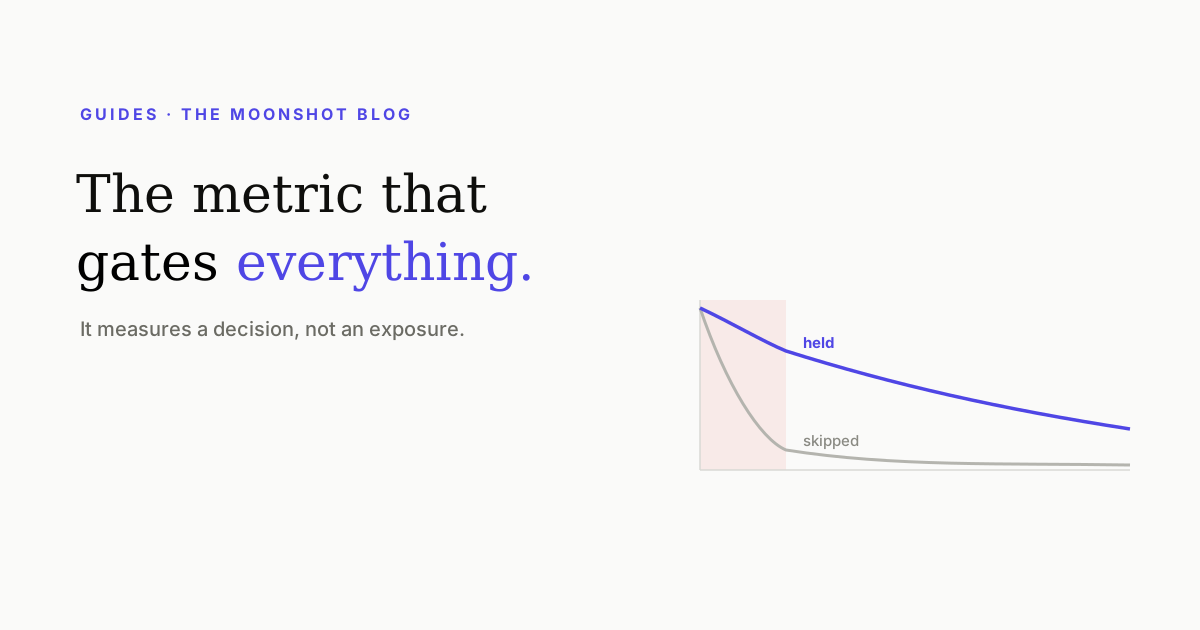
Instagram does not have one algorithm. It has recommendation and ranking systems for different surfaces, each predicting what a particular person is likely to value. The creator’s useful question is not “what hack does the algorithm want?” It is “which stage of my viewer’s decision is failing, and what single change would test that?”
A better mental model: eligibility, understanding, testing, expansion
“The algorithm” sounds like a judge assigning one permanent quality score. A more useful model is a sequence of opportunities. First a post must be eligible for recommendation. Then the system must understand enough about it and the viewer to predict a match. The viewer’s response creates evidence, and that evidence can justify wider distribution.
Eligible
Public, recommendable and within Instagram's recommendation rules
Understood
Speech, on-screen text, caption and viewer history help identify the topic
Tested
A likely audience sees the Reel and creates early behavioural evidence
Expanded
Strong response earns opportunities with progressively colder viewers
This explains why two good videos can receive different reach. They may begin with different audience matches, compete against different posts at that moment, or produce a different early pattern. It also explains why copying the exact edit of a successful Reel does not copy its distribution.
Stage one: recommendation eligibility is a gate, not a boost
Instagram’s Recommendation Guidelines are stricter than the rules for content that is simply allowed to remain on the service. A public post can exist and still be ineligible for broad recommendation. Check Account Status before inventing a shadowban theory, especially after a sudden account-wide drop.
Originality is now a clear platform priority. That does not mean a talking head must invent a never-before-heard idea; it means the post should contain real creative value from you. A response, analysis, demonstration or story can transform source material. A lightly edited re-upload does not become original because captions were added.
Stage two and three: the signals form a sequence
Creators often collapse every action into “engagement.” That hides the diagnosis. A share happens after a person starts the video; a save usually happens after the value becomes clear. If almost nobody survives the first seconds, optimising the end-card request is work on a stage most viewers never reach.
| Failure | What you see | What to change next |
|---|---|---|
| People do not start | Very low reach or a sharp opening drop | Opening frame, first spoken line, immediate specificity |
| People start, then leave | Average watch time is weak for the runtime | Move the payoff earlier; cut setup and repetition |
| People watch, but do not spread it | Healthy viewing, few sends or saves | Add a useful takeaway, identity signal or surprising claim |
| People watch, but do not follow | Views without profile/follow conversion | Clarify the recurring topic and make the profile grid legible |
Read the table horizontally. Find the first weak stage and fix that before touching the ones after it. Our separate skip-rate guideexplains the opening measurement, while the no-views diagnostic covers four failure patterns in more detail.
What the system needs to understand the Reel
Recommendation systems need topic evidence. Your speech, the words visible in the video, the post caption and how interested viewers respond all contribute context. This is not an invitation to repeat a keyword twelve times. It is a reason to state the topic plainly.
- Say the concrete noun early. “This caption placement hides under the Reels buttons” is easier to classify and understand than “you are doing this wrong.”
- Put the real claim on screen. Designed captions help a muted viewer and make the topic explicit without adding a separate title card.
- Write a useful post caption. Add missing context or a compact summary; do not transcribe the entire video again.
- Use precise labels. A few relevant hashtags can describe a niche. Generic volume cannot substitute for clarity.
The five-post controlled test
Do not change topic, length, style, posting hour and CTA at once. You will not know what caused the result. Choose one recurring content format and make five posts with similar scope. Change one input at a time.
- Define the viewer. One sentence: “This is for X who needs Y.”
- Keep the promise family stable. Use five closely related questions, mistakes or examples.
- Test only the opening variable. Try direct claim, demonstration, contradiction, concrete result and story tension.
- Record at fixed intervals. Capture reach, average watch time, sends, saves, profile visits and follows after 24 hours and seven days.
- Reuse the winning mechanism. Do not copy the words; repeat what the opening did for the viewer.
Three myths to retire
“The right audio guarantees reach”
A relevant audio choice can help the experience and place a post in a familiar format. It cannot make a viewer care about an unclear promise.
“Posting daily trains the algorithm”
Frequency produces more observations and more chances to improve. Repetition without learning mostly produces a larger sample of the same problem.
“Better production always ranks better”
Production quality removes friction. A perfectly lit, slowly introduced idea can still lose to a direct phone recording that makes the value obvious in frame one.
Quick answers
What is the most important Instagram algorithm signal in 2026?
There is no single universal signal because Feed, Stories, Explore and Reels serve different jobs. For Reels, diagnose the sequence: whether people start, continue, finish and then share, save or visit. The weakest stage is more actionable than a generic engagement score.
Does Instagram favour original content?
Yes. Meta reported that 75% of US Instagram recommendations came from original posts in Q4 2025 after increasing their prevalence by ten percentage points. That is a system-level figure, not a guarantee that every original Reel receives reach.
Do hashtags make a Reel go viral?
Hashtags can add topical context, but they do not repair a weak opening or poor viewer response. Use a few precise labels when they help describe the content; do not treat a large hashtag block as distribution strategy.
Is there a best time to post Reels?
Posting while your likely viewers are active can improve the speed of early feedback, but there is no universal hour. Use your own audience insights and test comparable posts; timing cannot make irrelevant content relevant.
Should I delete and repost a Reel with low views?
Usually no. First diagnose the failure. If you retry, change the opening, framing or promise enough to create a meaningful new test rather than uploading the same file and hoping for a different sample.
Make the opening readable before the first swipe
Moonshot turns the spoken clip into word-timed captions, lets you repair the transcript and previews 140 complete caption systems on your footage.
Build captions for a Reel →